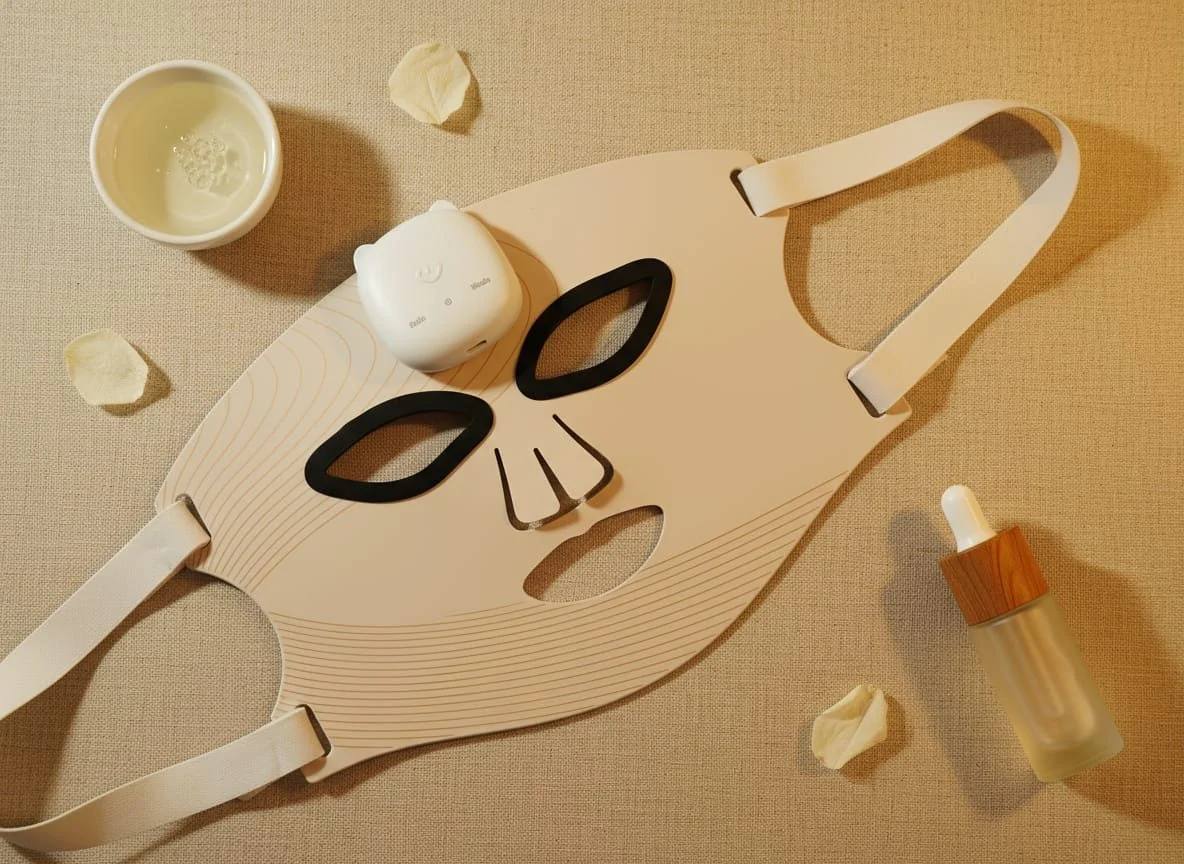
Device Comparison · SKIN TECH HUB
LED Mask vs EMS vs Microcurrent Device: Principles, Evidence and How to Choose
LED masks treat skin with specific wavelengths of light; EMS uses electrical current strong enough to contract muscles; microcurrent uses far lower, usually imperceptible current. Marketing often blurs the three, but their targets, evidence and contraindications differ. This guide separates the technologies and compares goals, feel, medium requirements, evidence maturity and safety boundaries.
The short answer
An LED mask is light-based care: it shines specific wavelengths onto the skin. EMS and microcurrent are current-based care: EMS uses current strong enough to contract muscles, while microcurrent uses far lower current that most users cannot feel. They act on different targets, carry different evidence and different contraindications, and should not be conflated. Which category suits you depends on whether your goal is “skin-quality appearance” or a “muscle-level firming sensation” — not on which one sounds more powerful.
The principle: three technologies, three different things
LED light-therapy masks (photobiomodulation) shine visible light of specific wavelengths onto the skin and involve no electrical current at all. In terms of research direction, red light appears more often in studies on photoageing, fine lines and the look of skin quality, while blue light appears more often in research on mild to moderate inflammatory acne. A systematic review and meta-analysis found that red and blue LEDs play a role in acne research, with red light also showing potential for skin rejuvenation.Source 1 The Cleveland Clinic also notes that home LED masks are usually gentler than clinic equipment, so improvements may be modest.Source 2 For what each light colour is studied for and its safety notes, see our guide to LED light colours.
EMS (electrical muscle stimulation) delivers current through electrodes on the skin at an intensity strong enough to produce a visible or palpable muscle contraction. The US FDA regulates electrical muscle stimulators as medical devices and states that they may be able to temporarily strengthen, tone or firm a muscle; no EMS device has been cleared for weight loss, girth reduction or dramatic reshaping claims.Source 3
Microcurrent belongs to the same current-based family but runs at far lower intensities (measured in microamps), and most users feel no muscle twitching at all. In the FDA’s 510(k) database, a microcurrent beauty device such as the NuFace (K072260) is classified as a “transcutaneous electrical stimulator for aesthetic purposes” — a different positioning from therapeutic EMS.Source 5 Marketing often treats “EMS” and “microcurrent” as synonyms, but they differ in intensity and design intent. And the cellular-level mechanisms often quoted for microcurrent (such as ATP production) come mainly from laboratory research — they do not amount to solid evidence of cosmetic benefit at home.
In short: LED targets how skin responds to light; EMS and microcurrent target how muscle and tissue respond to current. The two categories should not be conflated, and study results from one cannot be borrowed by the other.
How do their skincare goals differ?
An LED mask’s goals revolve around the appearance of skin quality — fine lines, even-looking tone, supportive care for acne-prone skin — a “skin-level” direction. EMS and microcurrent devices revolve around muscle activity and the feel of facial contour — many users are after a firmer look right after a session, or the sensation of facial muscles being engaged — a “muscle-level” direction.
One thing to keep in mind: most EMS devices reviewed by the FDA are intended for physical therapy and rehabilitation, and the agency emphasises that their effects mainly support muscle function rather than dramatically changing appearance.Source 3 Home beauty devices are usually gentler still, so “face-slimming”, “lifting” or “fat-melting” claims are not supported by evidence and are not promises any current-based device should make — treat such marketing as a red flag.
Side by side: LED mask vs EMS vs microcurrent
The table below summarises the general differences between the three categories. Always defer to each product’s own specifications, instructions and warnings.
| Aspect | LED light-therapy mask | EMS muscle stimulator | Microcurrent device |
|---|---|---|---|
| How it works | Shines visible light of specific wavelengths onto the skin — light-based care. | Delivers current through electrodes to contract muscles visibly or palpably. | Delivers microamp-level current, far below EMS, as gentle stimulation; twitching is usually not felt. |
| Where it acts | Skin level. | Muscle level. | Gentle electrical stimulation across skin, subcutaneous tissue and muscle. |
| Main skincare goals | Skin-quality appearance: research directions include fine lines, tone and supportive care for acne-prone skin. | Muscle-level goals: per the FDA, EMS may temporarily strengthen, tone or firm a muscle. | A firmer look and facial-contour sensation; independent research for at-home cosmetic use is limited. |
| What it feels like | Hands-free wearable; no electrical sensation. Any warmth depends on the device and the individual. | Handheld gliding or fixed electrodes; pronounced tingling or muscle twitching is common. | Handheld gliding; usually only mild tingling, or nothing at all. |
| Medium requirements | Usually worn on clean, dry skin; skincare is typically applied after the light session. | Usually needs a water-based conductive medium — follow the model’s instructions. | Some models need a water-based conductive medium; some state no special gel is required. Follow the model’s instructions. |
| Evidence maturity | Red and blue light are relatively well studied, but findings apply only to the wavelengths and doses used. | Longer evidence history in medical rehabilitation; limited for at-home cosmetic use. | At-home cosmetic research is quite limited; the longest follow-up is around 12 weeks. |
| Key safety concerns | Photosensitivity, eye protection, photosensitising medication. | Implanted electronic devices (e.g. pacemakers), heart-rhythm problems, epilepsy, pregnancy, the front of the neck and the eyeball area, broken or inflamed skin. | |
How to read the evidence: a studied device is not the device in your hand
For LED, red and blue light are relatively well studied in skin research, but the conclusions apply only to the wavelengths, energies and doses used in those studies; masks vary widely in their LEDs, output and treatment distance, so no single study should be mapped directly onto a specific product.Source 1
For microcurrent, Bu and colleagues’ 2024 review of home beauty devices notes explicitly that research reports on at-home microcurrent devices are relatively scarce. They describe one randomised controlled trial (Slendertone Face; 56 participants in the neuromuscular electrical stimulation group and 52 controls, five sessions per week for 12 weeks) in which the treatment group showed better facial radiance, skin tone and wrinkle scores than controls, an 18.7% increase in muscle thickness versus baseline at weeks 5–6, and only mild redness as an adverse reaction.Source 6 Importantly, this trial used neuromuscular electrical stimulation (NMES), which runs at a higher output than typical microcurrent devices — its results therefore cannot serve as evidence of efficacy for low-intensity microcurrent, nor can they be generalised to all microcurrent products on the market. Home devices also deliver lower energy than medical equipment, and their effectiveness remains debated.Source 6
On safety data, Kadam and Lipner (2026) analysed 28 adverse-event reports for at-home microcurrent facial devices in the US FDA’s MAUDE database, including arrhythmia, pain, dizziness, headache, inflammation and one case of retinal detachment. The authors stress that MAUDE is a voluntary reporting system — serious events are more likely to be reported, there is no denominator for incidence rates, and reports cannot prove causation. Randomised trials have mostly reported only mild redness, but the longest follow-up was just 12 weeks, so long-term safety data are lacking; they advise that people with cardiac conditions or implanted devices consult a physician before use.Source 7
The right reading of all this: microcurrent is neither “dangerous” nor “proven to work” — the evidence is simply still early. Follow the manual and the contraindications, and keep expectations realistic.
Skincare and medium requirements
This is one of the most overlooked differences. Because an LED mask passes no current through the skin, it is usually worn after cleansing on dry skin, with your regular skincare applied once the light session is over. Some products advise avoiding certain ingredients immediately before light exposure — check the manual. For actual usage steps, frequency and skincare order, see our guide to using an LED face mask.
EMS and microcurrent devices rely on current travelling through the skin. Some models require a water-based conductive gel or serum to support conduction and reduce localised discomfort, while certain mask-style models officially state that no special gel is needed. Whether a medium is required, which product is suitable, how much to use and how often — all of this must follow the actual model’s instructions. Do not copy settings across models, and do not substitute another skincare product for the conductive medium on your own.
What they feel like in a daily routine
An LED mask is a “wear-and-relax” experience: your hands stay free and there is no electrical stimulation. Any sensation of warmth depends on the device and the individual, making it easy to fold into an evening wind-down. An EMS device is a “hands-on” experience: you glide it across the face or hold electrodes in place, and pronounced tingling or muscle twitching is common. Microcurrent sits between the two — it is worked area by area like EMS, but the sensation is usually far milder. First-time users of any current-based device are generally advised to start at the lowest intensity.
All three require consistent use as directed before any change is likely to show, and none should be expected to deliver visible results from a single session. When choosing, ask yourself honestly: would you rather wear something hands-free, or work area by area?
Safety and contraindications
LED masks: if you have photosensitivity, a skin or eye condition, are pregnant, or take medication that may increase photosensitivity, consult a professional before use, and pay attention to the product’s eye-protection design and session-time limits.
EMS and microcurrent devices: the FDA says it has received reports of shocks, burns, bruising, skin irritation and pain associated with some devices, along with a few reports of interference with implanted devices such as pacemakers and defibrillators.Source 3 The FDA’s guidance for manufacturers also states that powered muscle stimulators should not be used on patients with cardiac demand pacemakers, and notes that the long-term effects of chronic electrical stimulation are unknown.Source 4 In general, implanted electronic devices (such as pacemakers), heart-rhythm problems, epilepsy, pregnancy, the front of the neck and the carotid area, the eyeball and eye area, the chest, and broken or inflamed skin are all situations where a doctor should be consulted first. Contraindications vary by model — defer to the manual rather than generalising across devices.
Stop signals: with any device, stop immediately if you experience burning, persistent redness or swelling, dizziness, palpitations, visual discomfort, or abnormal muscle twitching or numbness. If discomfort persists, see a doctor — don’t guess.
This article is general beauty information. None of these device types should be used to diagnose, treat or prevent disease; persistent skin or health concerns should be assessed by a doctor first.
A brief note on RF
RF (radiofrequency) is a third common home-device category. It works through the thermal effect of current heating deeper skin layers, which is different again from LED (light) and EMS/microcurrent (electrical stimulation). Home RF has its own requirements around energy, technique and contraindications (metal implants, pregnancy, burn risk), which we will not expand on here; as with any device, defer to the official specifications, warnings and manual before buying.
How to choose the right category for you
Start from your goal:
- If you mainly care about skin quality, fine lines or acne-prone skin, begin by reading up on LED light-therapy research; for a specification-level comparison of LED masks available in Hong Kong, see our LED mask comparison guide.
- If you mainly want to experience a muscle-level firming sensation, an EMS or microcurrent device sits closer to that design purpose — but keep realistic expectations: they will not slim your face, melt fat or replace in-clinic treatment.
- Two-in-one or all-in-one devices: combinations of LED, EMS, microcurrent and even RF in a single unit are common. Remember that each mode is an independent technology — the medium requirements, frequency, treatment areas and contraindications must each follow that mode’s instructions; never copy settings across modes.
Five things to compare before you buy
- Honest feature labelling: is it LED, EMS or microcurrent? Are wavelengths or current specifications clearly stated?
- Safety documentation: are warnings, contraindications, eye protection or implanted-device notes complete?
- Usage programme: are session times, recommended frequency and technique clear and easy to follow?
- Ongoing costs: some EMS/microcurrent models require ongoing conductive medium; others may not need a special gel.
- After-sales support: is there a clear warranty period and local support?
Once you have decided on an LED mask, use the home LED mask buying guide to check wavelength, dose, safety, warranty channels and total cost.
It is also worth being explicit: the RADIANT SKIN Wireless LED Face Mask is a light-therapy device and does not include EMS or microcurrent functions. If electrical-current care is what you want, choose a dedicated EMS or microcurrent product rather than expecting an LED mask to deliver the same experience.
Frequently asked questions
Can I use an LED mask and an EMS or microcurrent device on the same day?
There is no universal answer or fixed order; it depends on both manuals and your skin. Start by using them at separate times as directed and observe your skin’s response. If the electrical device requires a water-based conductive gel but the LED mask requires clean, dry skin, do not shine the LED through the gel; cleanse and dry the skin as instructed before using the other device. Do not add extra time or intensity yourself, and stop and seek professional advice if you are uncertain or develop discomfort.
Do microcurrent devices really need conductive gel?
Not necessarily. Some EMS and microcurrent devices need a water-based conductive medium, while certain mask-style models officially state that no special gel is required. Use only the medium recommended for the actual model, do not substitute another skincare product on your own, and do not copy usage frequency across models.
Can EMS or microcurrent slim my face, lift it or melt fat?
You should not expect that. The US FDA states that EMS devices may temporarily strengthen, tone or firm a muscle, but no EMS device has been cleared for weight loss, girth reduction or dramatic reshaping; independent research on at-home cosmetic microcurrent is also quite limited. Claims like “face-slimming”, “fat-melting” or “non-invasive facelift” are not supported by evidence.
Can I use EMS or an LED mask if I have a pacemaker?
FDA guidance states that powered muscle stimulators should not be used on patients with cardiac demand pacemakers, so EMS and microcurrent devices should be avoided. LED masks involve no electrical current, but anyone with an implanted device should still check with a doctor before buying any home beauty device.
How should I use a two-in-one or all-in-one beauty device?
Each mode is an independent technology: the medium requirements, usage frequency, treatment areas and contraindications for LED, EMS, microcurrent or RF must each follow that mode’s own instructions — never copy settings across modes. In any mode, stop immediately if you experience burning, persistent redness, dizziness, palpitations or visual discomfort.
Does the RADIANT SKIN mask have EMS or microcurrent?
No. The RADIANT SKIN Wireless LED Face Mask is a light-therapy device offering seven light colours; it does not include EMS or microcurrent functions. Before buying any beauty device, refer to the official specifications and manual.
Research and sources
The links below are for further reading. Research findings apply only to the devices, wavelengths, doses and participants studied — they are not a guarantee of any single product’s results.
- PubMed — Utilization of light-emitting diodes for skin therapy: Systematic review and meta-analysis
- Cleveland Clinic — LED Light Therapy
- U.S. FDA — Electronic Muscle Stimulators
- U.S. FDA — Guidance Document for Powered Muscle Stimulator 510(k)s
- U.S. FDA 510(k) K072260 — NuFace transcutaneous electrical stimulator for aesthetic purposes
- Bu P, et al. (2024) — Development of Home Beauty Devices for Facial Rejuvenation: Establishment of Efficacy Evaluation System, Clin Cosmet Investig Dermatol
- Kadam P, Lipner SR (2026) — Adverse Events Associated With At-Home Microcurrent Facial Devices, Cutis